Mobilize Remediation and Govern Exposure Risk Continuously
Assign ownership, coordinate corrective action, track remediation progress, verify fixes, and maintain the evidence required to support risk, compliance, and executive reporting.
Exposure Remediation and Governance
Remediation & Governance is the action and accountability layer of Teisoft Exposure Platform. It converts validated exposures into structured workflows with defined owners, priorities, due dates, supporting evidence, and measurable remediation status.
Security, IT, application, and cloud teams can coordinate corrective action, document risk decisions, verify completed fixes, and maintain a traceable history of each exposure from discovery through closure.
Validation evidence, remediation activity, retesting results, and risk decisions are consolidated into dashboards and reports for technical teams, executives, auditors, customers, and other authorized stakeholders.


















Built for Accountable Remediation and Risk Governance
Prescriptive Remediation & Root-Cause Guidance
Equip your technical team with clear, context-aware remediation instructions and configuration steps for permanent resolution. Eliminate guesswork and reduce time spent researching how to fix complex software or infrastructure vulnerabilities.
Centralized Workspace & Lifecycle Tracking
Manage the full status lifecycle of every exposure—from Open and In-Progress to Mitigated and Verified—directly within an intuitive platform dashboard. Maintain transparent visibility over finding owners, priorities, and resolution timelines.
Automated Re-Testing & Fix Verification
Eliminate manual verification overhead. Once a fix or mitigation is deployed, the platform initiates targeted re-testing against the asset to verify that the attack vector is closed, ensuring exposures don’t silently persist.
Executive Governance & Audit-Ready Reporting
Generate comprehensive, executive-ready PDF and CSV reports on demand. Track key risk metrics like Mean Time to Remediate (MTTR), monitor posture trends over time, and demonstrate compliance progress to auditors.
Why Finding Identification Does Not Equal Risk Reduction
Ownership Is Unclear
Findings remain unresolved when security, IT, development, cloud, and business teams do not have clearly defined responsibility for corrective action.
Remediation Progress Is Fragmented
Email threads, spreadsheets, scanner portals, and disconnected ticketing systems make it difficult to maintain a reliable view of status, deadlines, evidence, and unresolved risk.
Closed Tickets May Not Mean Fixed Risk
A task can be marked complete without confirming that the vulnerable condition was fully corrected. Retesting is required to verify the outcome.
Evidence Is Rebuilt Manually
When remediation activity is not captured continuously, teams must reconstruct records later for audits, customer requests, insurance reviews, and executive reporting.
Support Every Exposure Decision
Remediate
Correct the vulnerable condition and retest the affected asset.
Mitigate
Apply a compensating control or reduce exposure when immediate correction is not feasible.
Accept
Document an authorized decision to retain the risk for a defined period, including rationale, approver, and review date.
Defer
Postpone corrective action with documented dependencies, target dates, and continued monitoring.
Reopen
Return an exposure to active remediation when retesting shows that the condition remains present.
FAQs
What is Remediation & Governance?
Remediation & Governance is the process of turning identified exposures into accountable, trackable security actions.
Teisoft Exposure Platform™ helps organizations maintain visibility into open findings, monitor remediation progress, verify whether vulnerabilities have been resolved, and provide stakeholders with evidence of how external cyber risk is being managed over time.
Not every vulnerability can be eliminated immediately—or eliminated at all. Depending on its business context and available controls, an exposure may be remediated and closed, mitigated through compensating controls, formally accepted, deferred for later action, or determined to be no longer applicable.
What is the Mobilization phase in Gartner’s CTEM framework?
Mobilization is the final phase of CTEM, focused on operationalizing risk reduction. It ensures that validated exposures are clearly communicated with prescriptive guidance, prioritized, effectively remediated or mitigated, and automatically re-tested over time.
How does the platform help teams manage remediation?
The platform centralizes vulnerability findings, affected assets, technical evidence, risk context, and remediation guidance so teams can determine what must be addressed and why.
Users and teams can be organized within the platform to support clear responsibility for reviewing findings, coordinating corrective actions, and maintaining visibility across the exposure management program.
Does every identified vulnerability need to be closed?
No. CTEM is focused on reducing meaningful exposure and enabling informed risk decisions, not simply forcing every finding into a closed status.
Depending on the vulnerability, affected asset, business requirements, available compensating controls, and remediation feasibility, a risk may be:
Closed: The underlying vulnerability has been corrected and the resolution has been verified.
Mitigated: The vulnerability may still exist, but compensating controls have reduced its likelihood or potential impact.
Risk Accepted: The organization has formally decided to retain the risk after evaluating its potential impact, remediation cost, operational constraints, and business justification.
Deferred: Remediation has been approved but scheduled for a later date because of operational, technical, or business dependencies.
Not Applicable or False Positive: Review or validation has determined that the finding does not represent an applicable exposure under the assessed conditions.
These outcomes allow organizations to demonstrate that each relevant exposure has been evaluated and governed, even when complete technical remediation is not immediately possible.
How does Teisoft verify that a vulnerability has been remediated?
A finding is not considered resolved solely because a corrective action was reported as completed. The affected asset can be reassessed to determine whether the vulnerability is still detectable.
Previously identified findings that remain present are maintained as carryover findings. Issues that are no longer detected during a subsequent assessment can be reconciled as closed based on the evidence collected by the platform.
Can Teisoft help us validate a remediation before closing the finding?
Yes. A follow-up scan can verify whether the underlying exposure has been corrected.
Under the Teisoft-Managed model, Teisoft specialists can also review remediation results and supporting evidence when additional technical analysis is required. This helps prevent findings from being closed prematurely or remaining open after they have already been resolved.
How does the platform show risk-treatment progress over time?
Teisoft Exposure Platform preserves historical context across assessments. Reports can distinguish between newly identified vulnerabilities, unresolved carryover findings, findings verified as closed, and risks being managed through other approved treatment decisions.
This allows security and IT leaders to understand:
- Which exposures have been eliminated.
- Which remain open and require action.
- Which have been mitigated through compensating controls.
- Which have been formally accepted or deferred.
- Which findings are no longer applicable.
This provides a more accurate view of risk reduction than measuring success only by the number of vulnerabilities marked as closed.
What information is available for technical remediation teams?
Detailed findings can include the affected asset, severity, vulnerability classification, technical description, potential impact, recommended corrective actions, supporting references, and scanner evidence.
This gives infrastructure, application, and security teams the information needed to understand the issue and determine whether it should be remediated, mitigated, accepted, or addressed through another approved treatment.
What reporting is available for executives and security teams?
Reports are designed to support both executive and technical audiences.
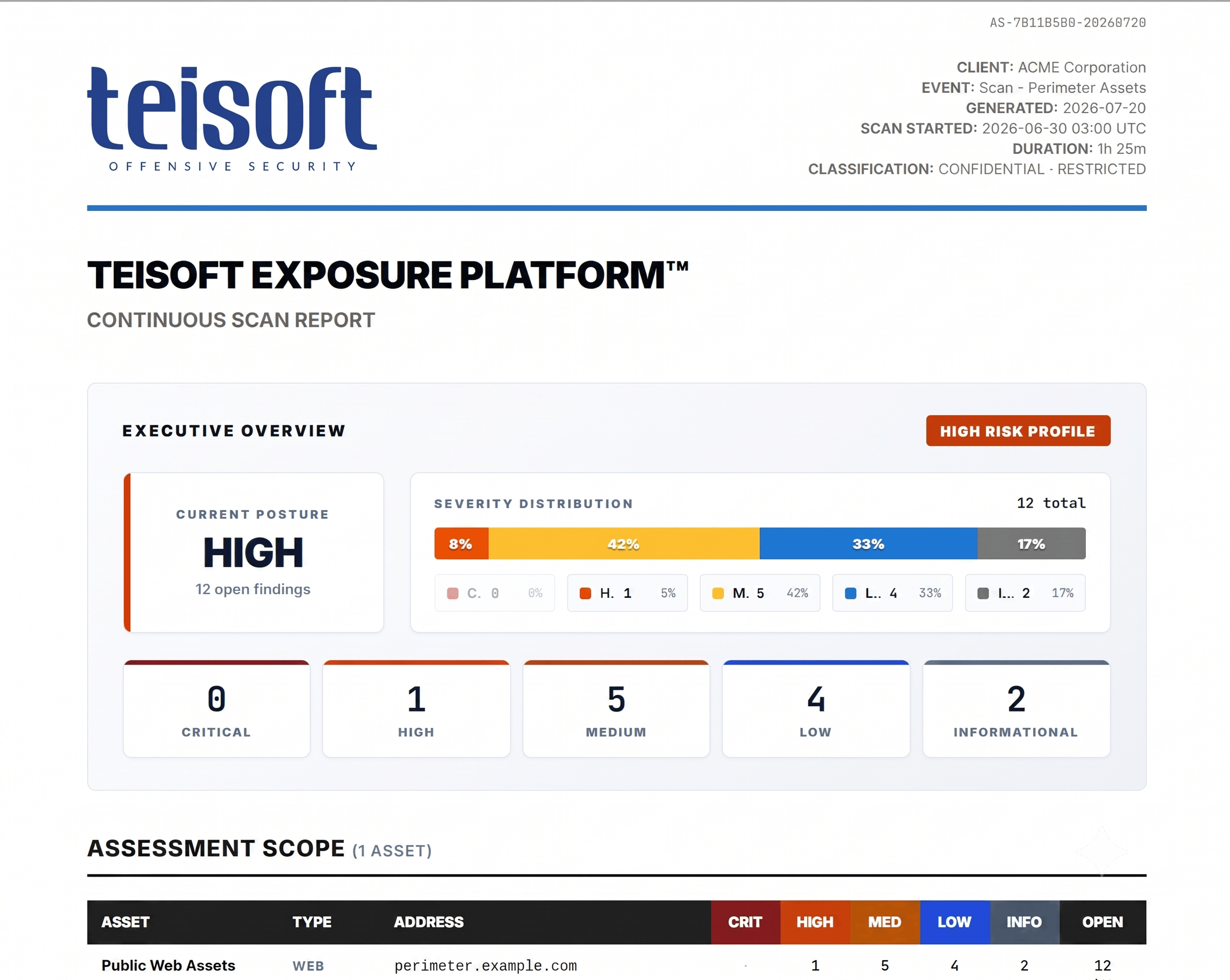
Executive-level information can include the organization’s current risk posture, severity distribution, assessment scope, security strengths, primary areas of concern, and risk-treatment progress. Technical sections can provide detailed findings, evidence, remediation guidance, unresolved exposures, carryover findings, compensating controls, and issues verified as closed.
This allows leadership to understand not only how many vulnerabilities exist, but also how the organization has decided to treat and govern them.
Can the platform support multiple users and teams?
Yes. Organizations can manage users and teams within Teisoft Exposure Platform to support collaboration across security, IT, infrastructure, application, risk, and management functions.
This helps ensure that the appropriate stakeholders can review findings, coordinate corrective actions, approve risk-treatment decisions, and maintain a centralized view of the organization’s exposure management program.
Does Remediation & Governance help with audits and compliance activities?
Yes. The platform can provide documented evidence of assessments, identified findings, assigned responsibilities, remediation actions, compensating controls, risk acceptance decisions, and subsequent verification.
This information can support internal governance, risk reviews, customer security requests, cyber insurance processes, and compliance activities. However, the platform does not by itself guarantee compliance with a specific framework or replace a formal certification or audit performed by an authorized assessor.
What if we cannot immediately patch a critical vulnerability?
The platform provides prescriptive mitigation guidance to help you apply quick compensating controls. If perimeter shielding is needed, you can also engage Teisoft’s Managed WAF and DDoS protection services to block attack vectors while your developers work on a permanent patch.
Turn Validated Risk Into Measurable Action
See how Teisoft Exposure Platform™ helps teams assign ownership, coordinate remediation, verify fixes, and maintain audit-ready evidence through one continuous workflow.