

Penetration Testing Services: Understand What Attackers Could Exploit
Gain clear evidence of which weaknesses present real risk, how they could affect critical systems and data, and what your team should fix first.
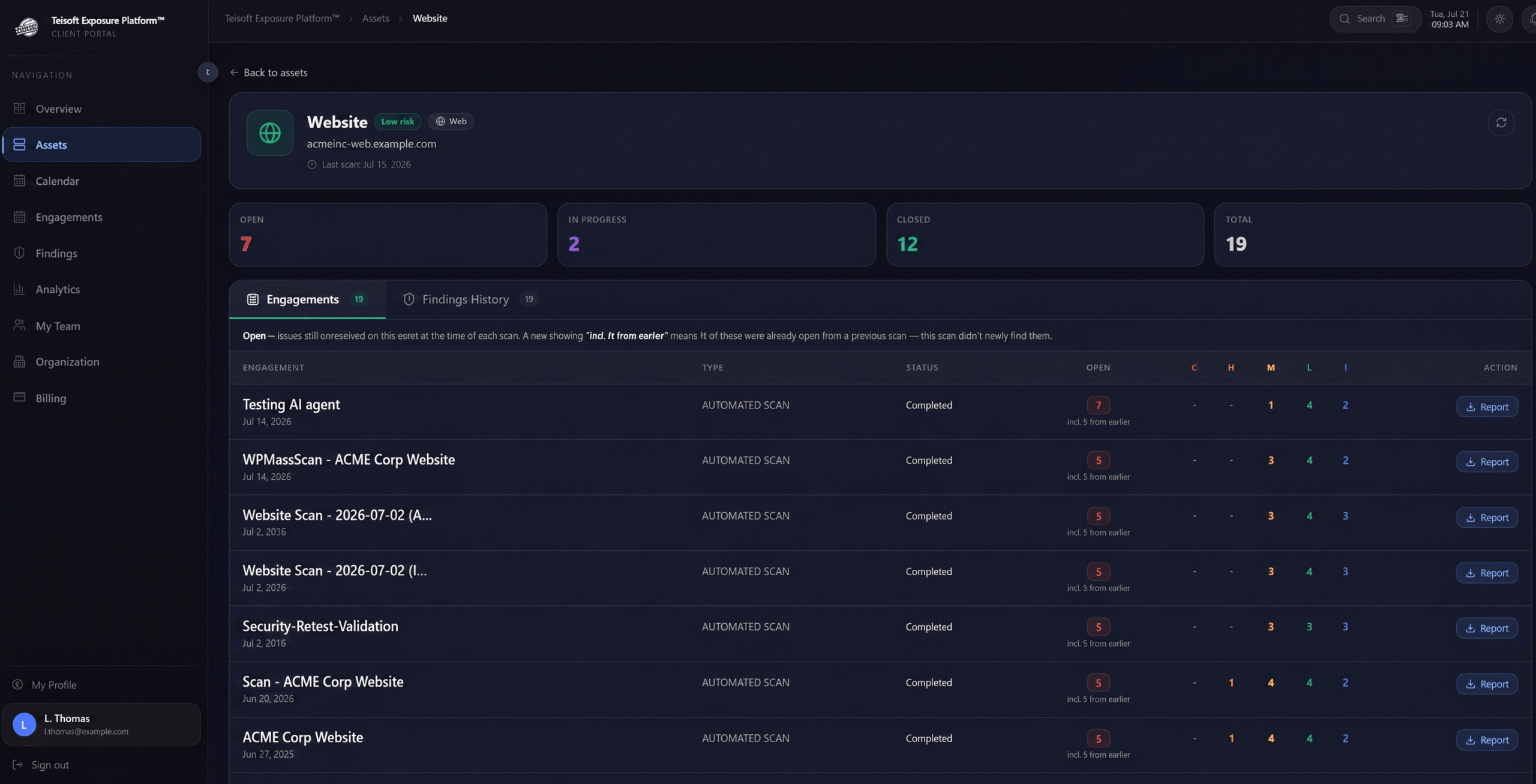
Expert-Led Testing Based on Real Attack Paths
Penetration testing goes beyond identifying potential vulnerabilities. It examines whether weaknesses can be exploited, combined, or used to gain unauthorized access to applications, systems, accounts, or sensitive information.
Teisoft combines automated discovery, manual testing, technical analysis, and professional judgment to evaluate how an authorized attacker could interact with the environment. Testing may cover authentication, authorization, business logic, exposed services, cloud configurations, identity controls, trust relationships, and other conditions that automated scanners cannot reliably understand.
Every engagement is performed within an approved scope and documented rules of engagement designed to protect production systems and minimize unnecessary disruption.
Built for Real-World Security Validation
Validate Exploitable Risk
Determine whether identified weaknesses can be used to access data, accounts, functionality, systems, or other protected resources.
Reveal Chained Attack Paths
Identify how multiple weaknesses, misconfigurations, or trust relationships could be combined to create a more significant security impact.
Test Business Logic and Access Controls
Evaluate roles, permissions, application workflows, approval processes, and security assumptions that automated tools cannot interpret correctly.
Security Testing Across Applications and Infrastructure
Application Security Testing
Evaluate web applications for weaknesses involving authentication, access control, session management, input handling, sensitive data, and business logic.
API Security Testing
Examine APIs for authorization failures, excessive data exposure, token weaknesses, insecure integrations, rate-limit bypasses, and workflow abuse.
Infrastructure and Cloud Testing
Assess exposed services, internal networks, identity systems, cloud resources, security configurations, segmentation, and privilege boundaries.
Testing Aligned With Your Security Program
One-Time Penetration Testing
Assess a defined application, environment, release, or infrastructure scope during a scheduled engagement.
Continuous Penetration Testing
Perform recurring expert-led testing as applications, infrastructure, threats, and unresolved risks change over time.
Remediation Validation and Retesting
Verify whether corrective actions resolved the original weakness without introducing new security conditions.
Compliance and Assurance Testing
Support audit, customer, insurance, acquisition, and regulatory requirements with documented technical testing and evidence.
Why Automated Scans Do Not Replace Penetration Testing
Scanners Do Not Understand Business Logic
Automated tools may identify technical patterns without understanding how users, roles, transactions, and application workflows should behave.
Weaknesses Can Become More Serious When Combined
Several lower-severity conditions may create a significant attack path when chained together.
Authorization Failures Require Context
Determining whether one user can access another user’s data or functions often requires manual testing and role awareness.
Impact Must Be Demonstrated Carefully
A vulnerability name or severity score does not always explain what an attacker could actually accomplish in the tested environment.
FAQs
What is penetration testing?
Penetration testing is an authorized security assessment in which cybersecurity specialists simulate real-world attack techniques to identify weaknesses that could be exploited by an attacker.
Unlike automated scanning alone, a penetration test combines tools with expert-led analysis to evaluate how vulnerabilities, misconfigurations, access controls, and application behaviors could be used to compromise systems, sensitive data, or business operations.
What penetration testing services does Teisoft provide?
Teisoft provides penetration testing across:
- Web applications
- APIs
- External and internal infrastructure
- Cloud environments
- Compliance (PCI DSS), cyber insurance, and due diligence requirements
- Continuous penetration testing programs
The scope and methodology are adapted to the technologies, risks, and business objectives of each engagement.
How is penetration testing different from vulnerability scanning?
Vulnerability scanning uses automated tools to identify potential weaknesses across a defined environment. It is valuable for broad and recurring coverage, but it may not determine whether every finding is exploitable or how multiple weaknesses could be combined.
Penetration testing adds expert-led analysis, manual verification, and controlled exploitation. It helps determine whether vulnerabilities can produce a meaningful attack path and what impact a successful attacker could have on the organization.
Is Teisoft’s penetration testing automated or manual?
Teisoft uses both automated and manual testing.
Automated tools help provide broad coverage and identify potential exposures efficiently. Teisoft penetration testers then investigate the results, test security controls, examine attack paths, and manually evaluate issues that automated scanners may miss, including authorization weaknesses, business logic flaws, and vulnerabilities that require contextual analysis.
The engagement is not limited to delivering unverified scanner output.
Can penetration testing be performed against production systems?
Yes, when production testing is appropriate and specifically authorized.
Before testing begins, Teisoft defines the approved scope, testing window, permitted techniques, communication procedures, and any systems or actions that must be excluded. Testing is designed to minimize operational risk, and potentially destructive techniques are not performed without explicit authorization.
When production testing would introduce unacceptable risk, the assessment can be performed in a representative staging or testing environment.
How long does a penetration test take?
The duration depends on the size and complexity of the scope, the number of applications or systems, authentication requirements, testing depth, and the type of environment being assessed.
A smaller assessment may be completed within several business days, while more complex applications, APIs, infrastructure, or cloud environments may require multiple weeks. Teisoft defines the estimated timeline after reviewing the scope and testing requirements.
What information does Teisoft need before testing begins?
Getting started is straightforward. Teisoft guides your team through a short scoping process to confirm what will be tested, the engagement objectives, and any operational restrictions.
In most cases, we can begin with a list of the applications, APIs, domains, IP addresses, or cloud environments to be assessed. If authenticated testing is included, we may also request test accounts or available API documentation.
Your team does not need to prepare a complete technical package before contacting us. Teisoft will help identify the information needed for the selected type of penetration test and keep the onboarding process focused and efficient.
What deliverables are included?
The engagement includes a penetration testing report designed for both executive and technical stakeholders.
Deliverables may include:
- Executive summary and overall risk assessment
- Testing scope and methodology
- Confirmed vulnerabilities and affected assets
- Severity and risk classifications
- Technical evidence and reproduction details
- Potential business impact
- Prioritized remediation recommendations
- Supporting references
- A summary of positive security controls observed during testing
The objective is to provide actionable evidence that technical teams can use to remediate findings and leadership can use to understand business risk.
Does Teisoft include remediation guidance and retesting?
Yes. Confirmed findings include remediation guidance intended to help technical teams understand the corrective action required.
After the customer completes remediation, Teisoft can retest the affected findings to determine whether the underlying vulnerabilities have been resolved. Retesting results can be documented so the organization has evidence of which findings were closed and which may require additional work.
The proposal or statement of work will specify the retesting period and number of retests included in the engagement.
How often should penetration testing be performed?
Many organizations perform penetration testing at least annually, but frequency should reflect the organization’s risk profile and rate of change.
Additional testing may be appropriate:
- After significant application or infrastructure changes
- Before launching a critical system
- After introducing new APIs or cloud services
- Following a security incident
- When required by a customer, insurer, contract, or compliance framework
- When systems change frequently enough to justify continuous penetration testing
Annual testing provides a point-in-time assessment. Organizations with rapidly changing or business-critical systems may benefit from more frequent validation.
Can Teisoft perform penetration testing for PCI DSS and other compliance requirements?
Yes. Teisoft performs penetration testing to support PCI DSS requirements, as well as cyber insurance, customer security reviews, compliance initiatives, and acquisition due diligence.
Organizations subject to the applicable PCI DSS penetration testing requirements must perform internal and external penetration testing at least once every 12 months and after significant changes to the environment. Teisoft can help define the appropriate scope, perform the required testing, document confirmed findings, and provide remediation and retesting evidence.
The engagement can also be aligned with the technical evidence requested by auditors, customers, insurers, or other stakeholders. A penetration test supports the compliance process, but it does not by itself certify the organization as compliant or replace an assessment that must be completed by a specifically qualified assessor.
Will Teisoft help us understand which findings should be addressed first?
Yes. Findings are prioritized using more than technical severity alone.
Teisoft considers factors such as exploitability, affected functionality, external accessibility, required attacker privileges, sensitive data exposure, potential attack paths, and business impact. This helps remediation teams focus first on the weaknesses most likely to create meaningful risk rather than treating every finding as equally urgent.
Find Out What an Attacker Could Actually Exploit
Discuss Your Penetration Testing Scope
Launch continuous assessments, track findings live, and validate fixes from a centralized platform.