
Prioritize the Exposures That Threaten Business Continuity
Filter out the noise of thousands of alerts. Analyze vulnerabilities based on threat intelligence, asset criticality, and real-world exploitability to focus your team on what matters most.
Risk-Based Vulnerability Management
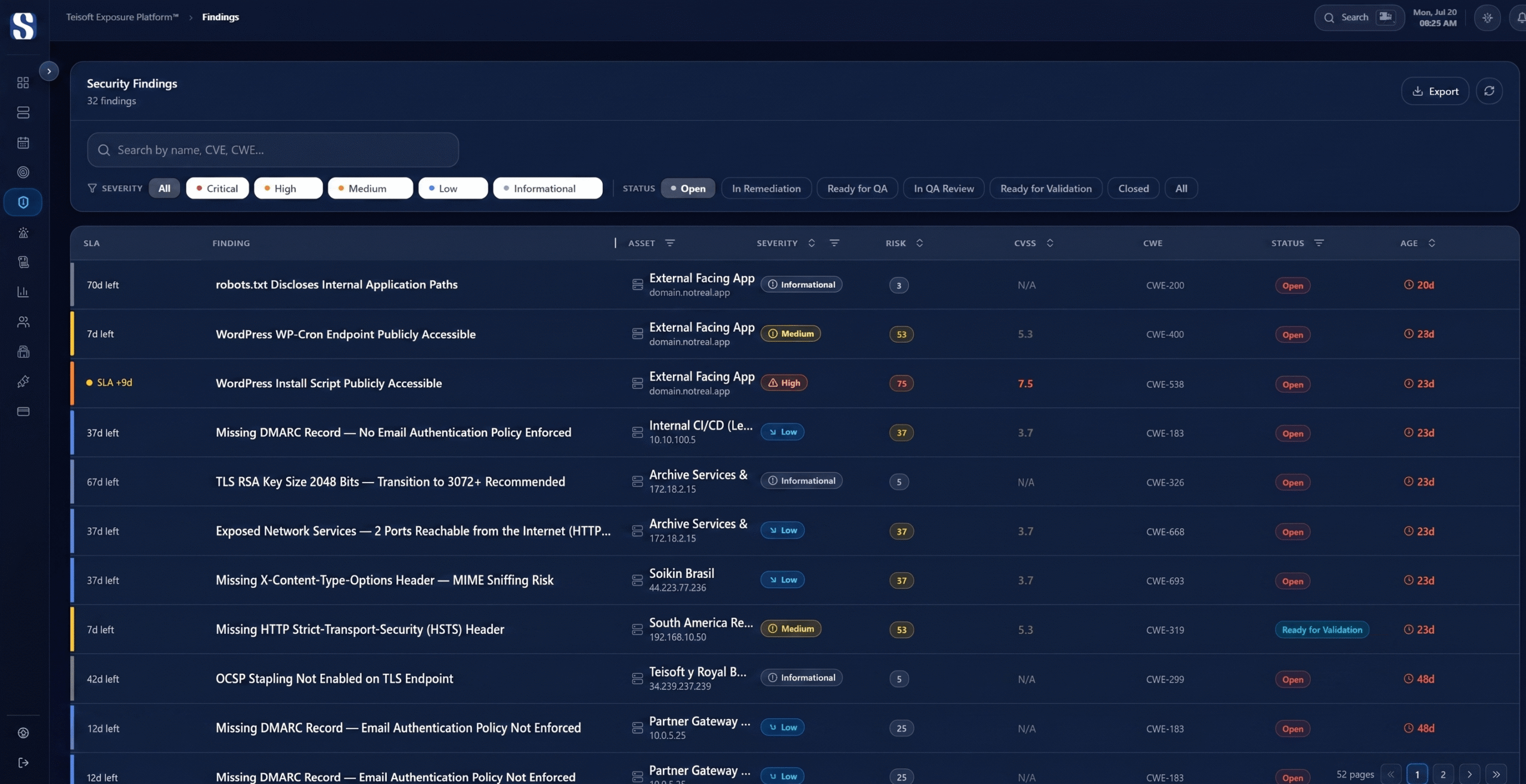
Risk-based vulnerability management transforms raw EASM data into actionable intelligence to operationalize your CTEM program. This layer identifies vulnerabilities and misconfigurations across your discovered assets, deduplicates overlapping findings, and prioritizes them using exploitability metrics and specific asset criticality. Teams focus exclusively on exposures that present material risk to the business.



















Continuous Exposure Management That Drives Action
Real-World Threat & Exploit Intelligence
Integrate live feeds from CISA KEV, dark web exposure channels, and public PoC repositories. Automatically escalate exposures that are actively exploited in the wild or targeted by active threat campaigns.
Business-Centric Asset Scoring
Incorporate operational context, data sensitivity, and business criticality into every risk calculation. A moderate vulnerability on a core transaction endpoint always ranks higher than a critical bug on a dev server.
Attack Path & Reachability Analysis
Analyze how isolated exposures interlink across your architecture. Evaluate contextual reachability to elevate risk scores for gateway assets that offer direct pathways to internal High-Value Assets (HVAs).
Compensating Control Awareness
Factor in active security controls like WAF rules, network segmentation, and rate-limiting. Reduce score inflation for exposures that are already shielded by existing security measures.
Unified Risk Scoring Beyond CVEs
Prioritize misconfigurations, exposed API keys, leaked credentials, and weak SSL protocols alongside traditional software vulnerabilities (CVEs) in a single, normalized dashboard.
SLA Tracking & Remediation
Track remediation progress against defined SLAs to improve accountability, reduce risk exposure windows, and support compliance requirements.
Why Severity-Only Prioritization Falls Short
Too Many “Critical” Findings
Technical severity scores can identify potentially serious weaknesses, but they do not always indicate whether a finding is externally reachable or likely to affect a critical business service.
Missing Business Context
The same vulnerability can represent very different levels of risk depending on the affected asset, its role, the data it processes, and its importance to business operations.
Remediation Effort Is Misaligned
Without contextual prioritization, teams may spend limited time fixing lower-impact findings while more relevant exposures remain unresolved or uninvestigated.
FAQs
What is Risk-Based Vulnerability Management?
Risk-Based Vulnerability Management is the process of identifying, evaluating, and prioritizing vulnerabilities according to the risk they represent to the organization—not simply their technical severity.
Teisoft Exposure Platform™ helps security and IT teams focus remediation efforts on the findings that matter most by considering the affected asset, its exposure, business importance, technical severity, available evidence, and the potential impact of exploitation.
What is Risk-Based Exposure Prioritization in CTEM?
Risk-Based Prioritization is the CTEM phase where identified exposures (vulnerabilities, misconfigurations, exposed credentials) are evaluated using threat intelligence, asset criticality, attack paths, and compensating controls to determine their true risk level to the business.
How is risk-based prioritization different from relying only on vulnerability severity?
Technical severity is important, but it does not provide the complete risk context.
A high-severity vulnerability affecting an isolated or noncritical asset may not require the same response as a medium-severity exposure on a public-facing system that supports an essential business process. Risk-based prioritization considers the vulnerability together with the asset and its operating context, helping teams make more informed remediation decisions.
How does Teisoft Exposure Platform prioritize vulnerability findings?
The platform organizes findings using factors such as technical severity, the affected asset, external accessibility, business criticality, recurrence across assessments, and supporting scanner or validation evidence.
When exposure validation is available, that evidence can further refine the priority by helping determine whether a finding represents a credible and actionable attack opportunity.
Does the platform help reduce vulnerability alert fatigue?
Yes. The objective is not to present every detected issue as equally urgent.
Teisoft Exposure Platform separates findings by severity and status, preserves the context of previously identified vulnerabilities, and helps teams distinguish immediate security concerns from lower-risk issues that can be addressed through planned maintenance.
This gives remediation teams a more manageable and defensible order of work instead of an undifferentiated list of scanner alerts.
Can a lower-severity vulnerability still receive a high remediation priority?
Yes. Technical severity and remediation priority are related, but they are not always the same.
A lower-severity finding may deserve faster attention when it affects a critical public-facing asset, enables another attack step, has been repeatedly left unresolved, or creates significant business, compliance, or brand risk. Conversely, a technically severe finding may require additional validation before it is treated as an immediate remediation priority.
How does the platform track recurring, resolved, and newly identified vulnerabilities?
Teisoft Exposure Platform maintains historical context across assessments rather than treating every scan as an isolated event.
Findings can be distinguished as:
- New findings identified during the latest assessment.
- Carryover findings that were previously identified and remain unresolved.
- Reconciled findings that are no longer detected and have been verified as closed through a subsequent assessment.
This allows teams to measure remediation progress, identify persistent risk, and demonstrate whether security issues are actually being resolved over time.
Can scanning frequency be aligned with the risk level of each asset?
Yes. Assets do not need to follow the same scanning schedule.
Critical, highly exposed, or frequently changing systems can be assessed more often, while stable or lower-risk assets can follow a less frequent cadence. This allows organizations to allocate their included scanning capacity according to risk and maintain broader coverage without applying the same schedule to every asset.
How does the platform account for existing security controls (like a WAF)?
Teisoft allows you to register active compensating controls. If an external exposure is verified to be mitigated by an active WAF or network control, the platform adjusts its priority score to prevent unnecessary triage overhead.
How does Teisoft use threat intelligence in prioritization?
The platform continuously correlates your asset exposures with threat intelligence sources, including CISA KEV (Known Exploited Vulnerabilities), dark web intelligence, and active exploit kit availability, automatically raising the priority of actively targeted weaknesses.
Focus Your Team on the Exposures That Matter Most
See how Teisoft Exposure Platform™ turns external asset and vulnerability data into a prioritized, explainable remediation workflow.