

Validate Real Risk Before You Remediate
Use controlled, non-disruptive automated testing to verify exploitability and focus remediation on exposures with meaningful business impact.
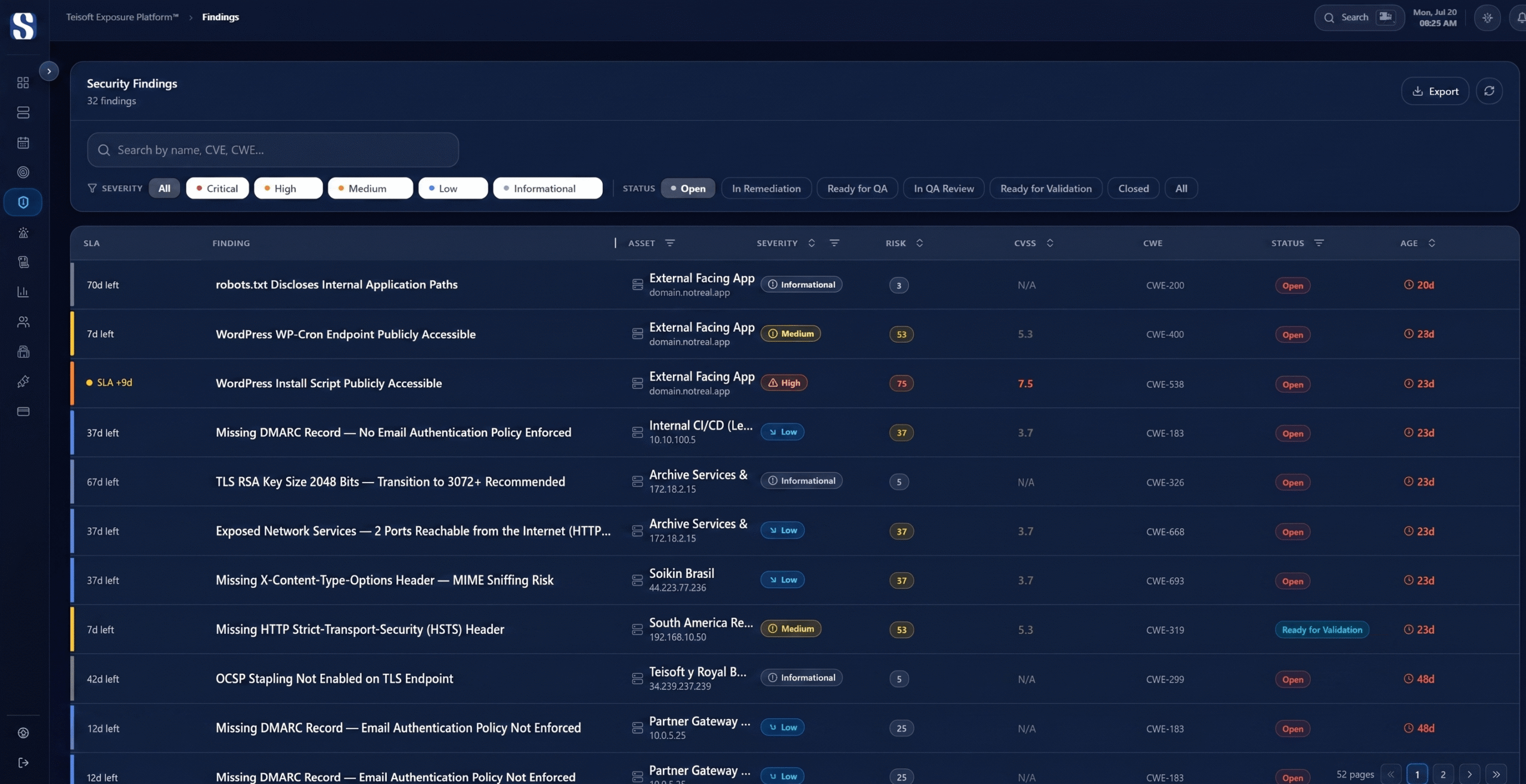
Automated Exposure Validation
Automated Exposure Validation is the verification layer of Teisoft Exposure Platform™. It evaluates prioritized exposures using controlled, non-disruptive testing techniques to determine whether the conditions required for exploitation are present in the customer’s environment.
The platform collects technical evidence, evaluates exposure conditions, and identifies findings that can be routed directly to remediation.
Validation results continuously update exposure priority, remediation status, and supporting evidence, giving security and IT teams a clearer basis for deciding what requires action.




















Built for Controlled, Evidence-Based Validation
Safe Exploit Validation & Non-Disruptive PoCs
Safely test vulnerabilities using non-destructive, controlled exploit payloads. Prove whether a flaw is genuinely exploitable in your live environment while minimizing the risk of downtime or service disruption.
Attack Path & Pivoting Validation
Go beyond single-asset checks. Validate how threat actors can chain multiple low-severity exposures together to pivot from internet-facing edge devices into your internal networks and High-Value Assets (HVAs).
Security Control Efficacy Testing
Verify if your existing security controls (WAF, EDR, IPS, rate limiters) actively detect and block exploitation attempts. Avoid unnecessary patching cycles when controls are already insulating the asset.
Automated Evidence & PoC Generation
Receive concrete, audit-ready evidence for every validated risk—including HTTP request/response logs, safe execution proofs, and payload responses—eliminating debates between security and development teams.
Adversary & Breach Simulation (BAS)
Simulate real-world adversary Tactics, Techniques, and Procedures (TTPs) mapped to the MITRE ATT&CK® framework to test your perimeter resilience against evolving threat actor behavior.
Hybrid Expert-Led Verification
Combine automated platform speed with expert manual verification. For complex business logic flaws and critical assets, our senior pentesters perform hands-on validation to deliver high-fidelity findings, reduce false positive noise, and ensure actionable context.
Why Detection Alone Is Not Enough
A Finding Is Not Proof of Exploitability
Scanners can identify potentially vulnerable conditions, but they do not always establish whether the exposure can be reached or used within the customer’s actual environment.
Isolated Findings Can Hide Attack Paths
Individual weaknesses may appear less important when reviewed separately but create greater risk when combined across exposed services, applications, or configurations.
Unvalidated Backlogs Waste Remediation Time
Without sufficient evidence, remediation teams may spend limited resources investigating low-confidence findings while more credible exposures remain unresolved.
FAQs
What is Automated Exposure Validation?
Automated Exposure Validation is the process of testing whether a detected vulnerability or security weakness can create a credible path to compromise.
Teisoft Exposure Platform™ uses controlled validation techniques to move beyond detection and provide additional evidence about whether an exposure is reachable, actionable, or potentially exploitable. This helps security teams distinguish confirmed risk from findings that may be technically present but difficult to use in a real-world attack.
What is Exposure Validation in Gartner’s CTEM framework?
Exposure Validation is the fourth phase of CTEM. It tests whether discovered exposures (vulnerabilities, misconfigurations, exposed credentials) can actually be exploited by an attacker in practice, and checks whether existing security controls successfully detect or block those attempts.
How is exposure validation different from vulnerability scanning?
Vulnerability scanning identifies potential weaknesses based on system behavior, configurations, software versions, and other technical evidence. Exposure validation takes the next step by assessing whether those weaknesses can be meaningfully used by an attacker.
Scanning answers, “What may be vulnerable?” Validation helps answer, “Which of these findings could actually expose the organization to compromise?”
Does exposure validation help reduce false positives?
Yes. Validation provides additional evidence that helps determine whether a scanner finding is applicable and actionable within the affected environment.
Findings that cannot be confirmed may require further review instead of being treated immediately as verified vulnerabilities. This reduces unnecessary remediation work and allows internal teams to concentrate on exposures supported by stronger technical evidence.
Validation does not mean that every unconfirmed finding is harmless. Some issues may require authenticated access, specific conditions, or expert analysis before their real risk can be determined.
Are automated validation activities safe for production systems?
Validation activities are designed to be controlled, scoped, and non-disruptive. They are performed only against authorized assets and within the boundaries established for the assessment.
The objective is to collect sufficient evidence without causing service interruption, modifying production data, or performing destructive exploitation. Tests that could introduce operational risk are excluded from automated execution or require separate authorization and expert review.
Does the platform automatically exploit every vulnerability it discovers?
No. Not every vulnerability can or should be automatically exploited.
Automated validation is used only when a safe and appropriate validation method is available. Some findings depend on business logic, authentication, user interaction, chained conditions, or techniques that could create unacceptable operational risk.
In those cases, the platform preserves the available evidence and the finding can be escalated for expert-led manual verification when required.
When is expert-led manual verification used?
Manual verification may be used when automated evidence is inconclusive, when the exposure requires specialized analysis, or when multiple weaknesses must be evaluated together as a potential attack path.
Under the Teisoft-Managed model, Teisoft security specialists can review the finding, analyze the surrounding context, and perform authorized manual testing when appropriate. This helps determine whether the exposure is credible, how it could affect the organization, and how urgently it should be remediated.
Can Teisoft validate attack paths involving multiple weaknesses?
Yes, when sufficient evidence and authorization are available.
A single lower-severity weakness may not represent significant risk on its own, but it can become more important when combined with other exposures. Validation helps identify whether individual findings could support a broader attack path, such as moving from an exposed service to unauthorized access or from information disclosure to a more damaging compromise.
This additional context helps organizations prioritize attack paths and business impact rather than relying exclusively on the severity of isolated findings.
How are validation results used in vulnerability prioritization?
Validation evidence is incorporated into the broader risk assessment of the finding.
A vulnerability supported by evidence of reachability or exploitability may receive a higher remediation priority than an issue with the same technical severity that cannot be reproduced under the assessed conditions. The results also help remediation teams understand why a finding matters and what security control must be corrected.
Is Automated Exposure Validation the same as penetration testing?
No. Automated Exposure Validation verifies selected exposure conditions using controlled automated techniques. Penetration testing is a separately scoped, expert-led security assessment that includes manual analysis, attack chaining, business-logic testing, and techniques that cannot be reliably automated.
Does Automated Exposure Validation replace penetration testing?
No. Automated Exposure Validation complements penetration testing but does not replace it.
Validation provides repeatable evidence for selected exposures identified during ongoing assessments. A penetration test typically examines a broader range of attack scenarios, including authentication, authorization, application logic, APIs, chained exploitation, and human-led techniques that cannot be fully automated.
Organizations can use continuous exposure validation to improve day-to-day prioritization while using penetration testing for deeper, point-in-time security assessments.
Validate Risk Before You Spend Time Remediating It
See how Teisoft Exposure Platform™ uses automated testing and expert human validation to reduce noise, identify credible attack paths, and support evidence-based remediation.